


Build Tomorrow's Capabilities Today
Create a disciplined system to anticipate, develop, mature, and scale the capabilities your organization will need before business demand becomes urgent.
Organizations invest significant time in strategies, projects, technologies, and organizational structures. Far fewer manage capability building with the same strategic discipline. Yet strategy can only be executed through capability.
A business may aspire to lead in AI, digital engineering, sustainability, advanced analytics, automation, product innovation, or new service models. But ambition alone does not create the collective knowledge, skills, processes, tools, governance, leadership, and experience required to perform consistently.
Capability gaps often remain invisible until they begin to delay strategic priorities. By then, the organization is forced to respond reactively — through urgent hiring, fragmented training, external dependency, or isolated initiatives that do not mature into enduring organizational strength.
Future-ready organizations take a different approach. They identify emerging capability needs early, make deliberate investment choices, develop capabilities through structured stages, and create an internal system for continuous renewal.
The useful life of organizational capabilities is becoming shorter. Technologies, customer expectations, regulations, business models, and competitive conditions are evolving rapidly. Capabilities that created success in the past may not be sufficient for the next phase of growth.
Organizations therefore face a dual challenge: Deliver today's business while building tomorrow's capability. This matters because:
- Strategic priorities increasingly depend on capabilities that do not yet exist at scale.
- Talent acquisition alone cannot create institutional capability.
- Training without application rarely produces business readiness.
- Emerging capabilities often develop inconsistently across teams.
- Critical expertise may remain concentrated in a few individuals.
- Leaders struggle to compare the readiness of different capabilities.
- Investment decisions are made without a common capability-development logic.
- New capability initiatives may lose momentum after initial enthusiasm.
- Functions can build similar capabilities independently, creating duplication.
- Organizations may become overly dependent on external partners for strategic knowledge.
Capability transformation gives leaders a structured way to prepare the organization for future value creation.
Common Challenges We See
- Which capabilities will matter most over the next three to five years?
- How do we prioritize investments?
- How do we avoid reacting too late?
- How do we balance today's execution with tomorrow's preparation?
- How do we measure capability maturity?
- How do we create sustainable organizational learning?
Questions Leadership Teams Are Asking
What capabilities will our strategy require over the next three to five years?
Which capabilities should we build internally?
Which should we buy, borrow, partner for, or access through an ecosystem?
How do we distinguish an individual skill from an organizational capability?
How do we assess whether a capability is genuinely mature?
How should we prioritize competing capability investments?
How do we build future capabilities while protecting current delivery?
How do we move from training programs to demonstrated business application?
How do we prevent critical expertise from remaining with a few individuals?
How do we scale a capability across teams, functions, or geographies?
What governance should be applied to capability development?
How do we measure capability-building progress?
How do we create a repeatable system rather than a series of disconnected initiatives?
How can we build internal capability without creating long-term dependence on external experts?
Capability transformation is one of the most overlooked drivers of long-term competitiveness.
At MV, we believe capability is more than the presence of skilled individuals. An organizational capability exists when the organization can repeatedly produce a desired outcome through an integrated combination of: people and expertise; processes and methods; tools and technology; data and knowledge; governance and ownership; practical application; leadership support; and learning and continuous improvement.
This means hiring experts or conducting training may contribute to capability development, but neither is sufficient on its own.
We also believe capability should be treated as a managed investment. Emerging capabilities should move through deliberate stages — from exploration and initial learning to demonstrated application, repeatability, scalability, and institutionalization. This creates better leadership visibility and more disciplined investment decisions.
Organizations do not become future-ready by accurately predicting every change. They become future-ready by building the capability to continuously adapt.
MV's role is to help organizations build both: the specific capabilities required for future success; and the internal discipline to identify and build new capabilities repeatedly.
Our goal is not to become indispensable to our clients, but to empower them to become self-sufficient.
From Emerging Need to Institutional Capability
MV's Capability Transformation approach can be structured across seven stages.
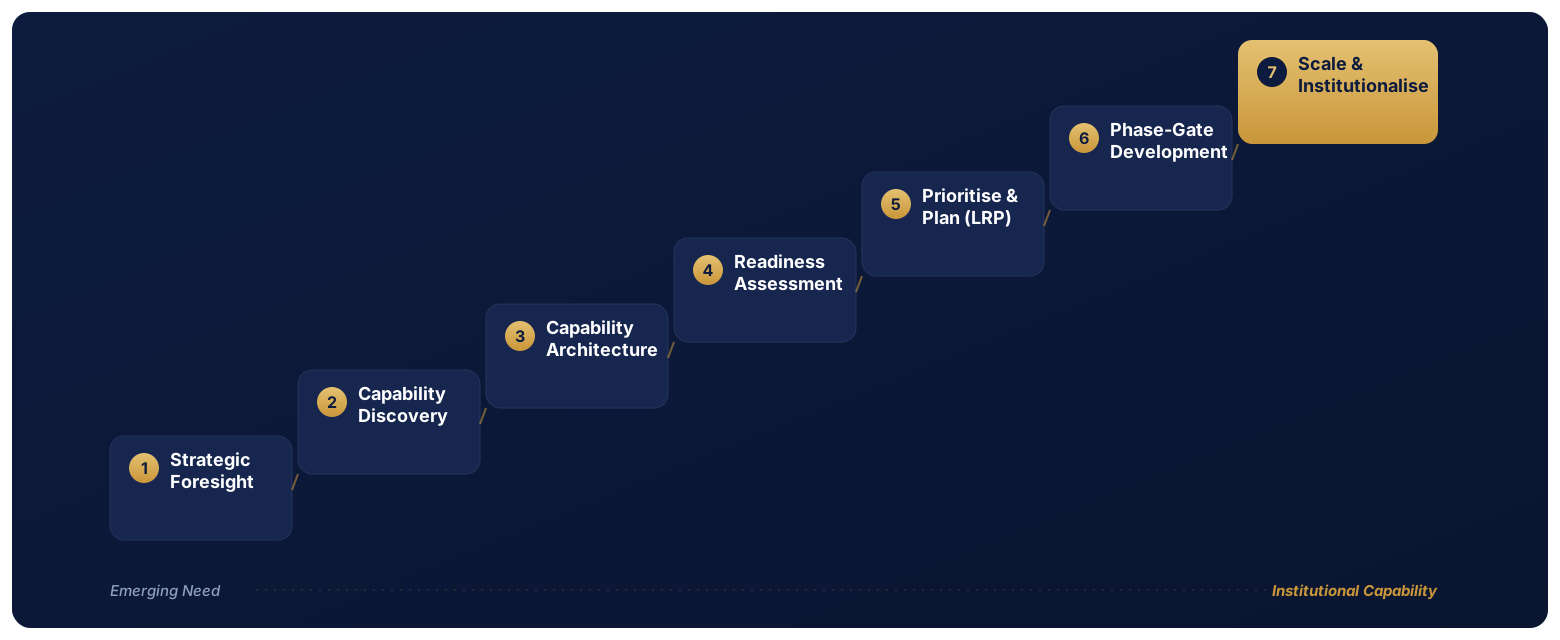
- 1
Strategic Foresight
Understand business strategy, technology shifts, customer expectations, market developments, and enterprise ambitions. The purpose is to identify capability demand before it becomes urgent.
- 2
Capability Discovery
Define the emerging capabilities the organization may need and describe what each capability must enable the business to do.
- 3
Capability Architecture
Break each capability into its essential components, including people, process, tools, data, governance, knowledge, partnerships, and application environments.
- 4
Readiness Assessment
Evaluate the current maturity of each capability using defined Capability Readiness Levels and evidence.
- 5
Prioritization and Long-Range Planning
Determine which capabilities to build, when to build them, what level of maturity is required, and how investments should be sequenced over a multi-year horizon.
- 6
Phase-Gate Capability Development
Progress each selected capability through structured development stages, with clear objectives, evidence, leadership reviews, and investment decisions at each gate.
- 7
Scale and Institutionalize
Embed the capability into operational work, develop communities and talent pipelines, codify knowledge, strengthen governance, and create continuous learning mechanisms.
A typical journey may include
What Organizations Typically Build Through This Journey
A Clear Future-Capability Agenda
A shared view of the capabilities the organization will need to execute its strategy.
Better Investment Prioritization
A structured basis for deciding which capabilities deserve immediate attention, staged development, partnership, or monitoring.
Visibility of Capability Readiness
A common language for understanding where each capability stands and what evidence is required to advance.
Stronger Strategic Workforce Planning
Better alignment between future capability demand, talent development, recruitment, learning, succession, and partnerships.
Faster Capability Maturation
A disciplined pathway from exploration to practical application, repeatability, and scale.
Improved Leadership Governance
Clear sponsors, owners, milestones, evidence, review gates, and decision criteria.
Reduced Dependency on Individuals
Knowledge, methods, processes, and experience are progressively embedded into the organization.
Greater Connection to Business Application
Capability development is linked to real business problems, pilots, projects, and measurable outcomes.
A Repeatable Capability-Building System
The organization develops the internal process to identify, build, assess, and scale future capabilities continuously.
Stronger Organizational Resilience
A workforce and operating system better prepared to respond to changing technologies, strategies, and business conditions.
Capability Building Shaped by Leadership Experience
Capability transformation is at the center of MV's philosophy. Vinod Kumar Rajan's leadership experience involved developing and scaling multiple capability portfolios within a global engineering GCC environment. This included both established organizational functions and emerging capabilities that required new talent, methods, governance, leadership sponsorship, and business application. This experience led to the development of structured approaches for capability progression, long-range capability planning, and phase-gated capability development.
MV's Distinctive Approach
Capability-first thinking: Strategy is translated into what the organization must become capable of doing.
Organizational — not individual — focus: Skills are integrated with process, tools, data, governance, and application.
Future orientation: Capabilities are anticipated before demand becomes urgent.
Evidence-based readiness: Progress is demonstrated through application, not declared through activity.
Phase-gated investment: Leaders can make informed decisions as capabilities mature.
Business integration: Capability development is connected to real enterprise needs.
Practical leadership governance: Ownership, sponsorship, reviews, and measures are built into the journey.
Knowledge institutionalization: The aim is to convert individual expertise into organizational strength.
Self-sufficiency: MV helps clients develop a repeatable internal discipline for continuous capability building.
Which Capabilities Will Your Strategy Depend on Tomorrow?
The right time to begin building them is before they become urgent. Let us explore the capabilities your future strategy requires, assess where you stand today, and create a disciplined path from emerging knowledge to enduring organizational strength.
Begin with one strategic capability or shape a long-range enterprise capability agenda.