


Reimagine Your GCC as a Strategic Enterprise Capability
Move beyond operational delivery to build a GCC that shapes enterprise strategy, accelerates transformation, develops future capabilities, and creates enduring business value.
Global Capability Centers have evolved far beyond their original mandate.
What began largely as a model for consolidating talent, improving efficiency, and scaling delivery is increasingly becoming a strategic engine for the enterprise. Leading GCCs are now expected to influence innovation, build critical capabilities, accelerate digital and AI transformation, strengthen resilience, and contribute directly to business outcomes.
Yet many GCCs continue to operate with structures, measures, and leadership expectations that were designed for an earlier stage of their journey. They may have achieved scale, operational maturity, and functional depth, but still face an important strategic question:
What must our GCC become next?
The answer cannot be found by simply adding more work, people, or functions. It requires a deliberate reimagination of the GCC's role, value proposition, capability portfolio, operating model, leadership system, and relationship with the global enterprise.
The expectations placed on GCCs are changing rapidly. Global businesses increasingly need their GCCs to:
- Lead enterprise-critical transformation, not only support execution.
- Build new capabilities before demand becomes urgent.
- Accelerate AI, digital, engineering, and operational innovation.
- Develop intellectual property, knowledge assets, and reusable solutions.
- Strengthen enterprise resilience through distributed capability.
- Attract and grow leaders who can operate with global influence.
- Demonstrate measurable business impact beyond productivity and cost.
At the same time, GCC leaders are navigating multiple pressures: evolving enterprise priorities, rapidly changing technologies, talent constraints, competing transformation initiatives, and rising expectations from global stakeholders.
Without an integrated direction, GCCs can become highly capable operationally while remaining fragmented strategically. The opportunity is therefore not simply to grow the GCC. It is to build an institution that continuously strengthens the enterprise.
Challenges We Often See
- The GCC has grown successfully, but its strategic role remains unclear.
- Capabilities have evolved organically rather than intentionally.
- Multiple transformation initiatives compete without a unified roadmap.
- Leadership teams struggle to define the next stage of GCC maturity.
- Success is measured operationally rather than strategically.
- Future capability investments are difficult to prioritize.
Questions GCC Leadership Teams Are Asking
What should the next chapter of our GCC look like?
How do we move from operational excellence to strategic enterprise influence?
What value should our GCC create over the next three to five years?
Which capabilities should we build locally, and which should remain globally distributed?
How do we align global business leaders and GCC leadership around one shared ambition?
How do we balance short-term delivery commitments with long-term capability development?
How should our operating model evolve as the GCC matures?
How do we strengthen ownership, accountability, and decision-making?
How do we integrate AI, digital transformation, engineering excellence, and capability building into one roadmap?
How should we measure GCC value beyond cost, headcount, and productivity?
How can the GCC create greater business impact without becoming disconnected from enterprise priorities?
How do we make transformation sustainable rather than dependent on a few leaders or external partners?
Every GCC follows a unique journey — but the most successful ones share one characteristic: they deliberately build capability before demand forces them to.
At MV, we believe GCC transformation is not a collection of improvement projects. It is the intentional evolution of the GCC as an enterprise capability.
A GCC becomes strategically valuable when five elements evolve together: its role in the enterprise; the value it is expected to create; the capabilities it chooses to build; the operating model through which it delivers; and the leadership and governance system that sustains progress.
We also believe there is no universal end-state for a GCC. Every organization has a different business context, maturity, heritage, talent base, and strategic ambition. Transformation must therefore be co-created, not imposed.
Our role is not to arrive with a predetermined operating model and ask the organization to conform to it. We work with leaders to clarify ambition, assess current reality, identify the most important strategic choices, and build a practical journey that the organization can own.
Our goal is not to become indispensable to our clients, but to empower them to become self-sufficient.
The strongest transformation is one that leaves behind stronger leaders, clearer governance, repeatable methods, and an internal capability to continue evolving.
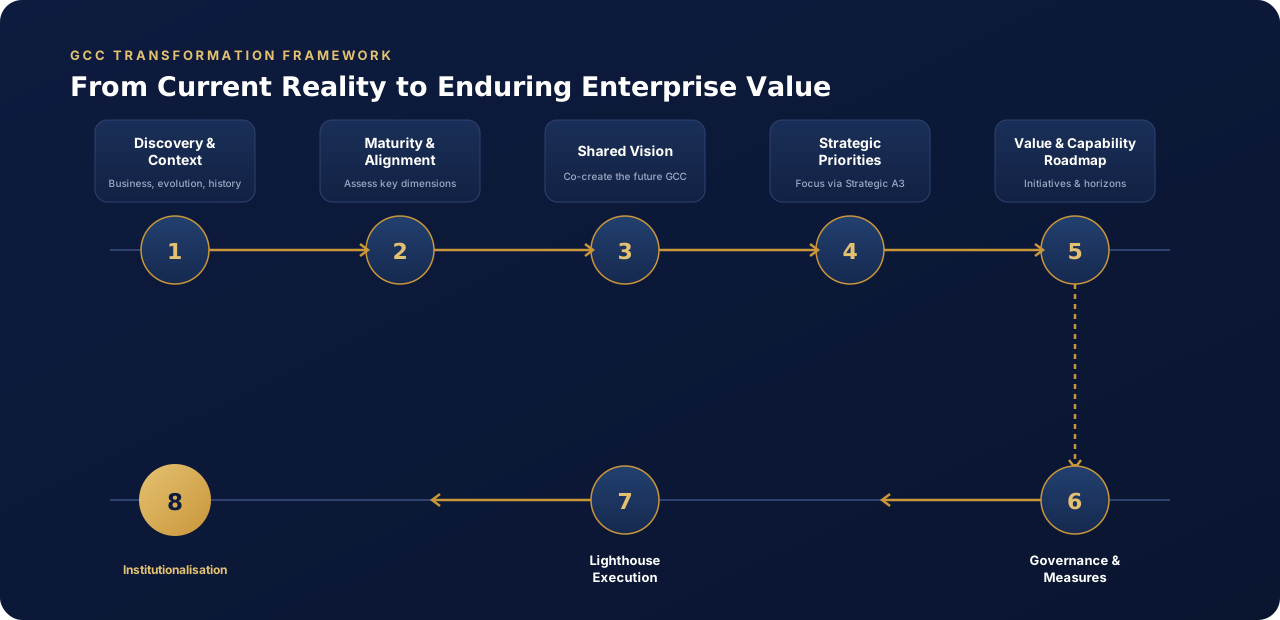
From Current Reality to Enduring Enterprise Value
MV's GCC Transformation approach can be structured across eight interconnected stages.
- 1
Discovery and Context
Understand the business, GCC evolution, stakeholder expectations, current challenges, strategic priorities, and transformation history.
- 2
Maturity and Alignment Assessment
Assess the GCC across relevant dimensions such as strategic alignment, enterprise influence, capability maturity, operating model, leadership, governance, talent, innovation, and value realization.
- 3
Shared Vision
Co-create a compelling view of what the GCC must become and the role it should play in the future enterprise.
- 4
Strategic Priorities
Translate the vision into a focused set of transformation priorities using structured strategic alignment tools such as a Strategic A3.
- 5
Value and Capability Roadmap
Define the capabilities, initiatives, operating-model shifts, and value horizons required to move from the current state to the desired future state.
- 6
Governance and Measures
Establish leadership ownership, decision rights, transformation governance, success measures, review cadences, and benefits tracking.
- 7
Lighthouse Execution
Select high-value initiatives that demonstrate the future model, build confidence, and create momentum.
- 8
Institutionalization
Embed transformation methods, capability-building disciplines, leadership routines, and continuous improvement mechanisms into the GCC.
A typical journey may draw on
The framework is adapted to the organization's context rather than applied as a fixed template.
What Organizations Typically Build Through This Journey
A Shared Strategic Direction
A clear and compelling view of the GCC's future role, understood and supported by both GCC and global leadership.
Stronger Enterprise Alignment
Better connection between GCC priorities and the strategic needs of businesses, functions, and global stakeholders.
A Focused Transformation Roadmap
A sequenced roadmap that balances immediate value creation with longer-term capability development.
Greater Strategic Influence
A GCC leadership team better equipped to shape enterprise conversations, not simply respond to demand.
A Future-Ready Capability Portfolio
Clarity on which capabilities to strengthen, create, scale, partner for, or discontinue.
An Evolved Operating Model
More effective structures, governance, interfaces, decision rights, and delivery mechanisms.
Better Measures of Value
A broader understanding of value that may include business outcomes, capability maturity, innovation, speed, quality, resilience, talent, and enterprise impact.
Stronger Leadership Ownership
A transformation owned by internal leaders, supported by repeatable governance and execution disciplines.
Sustainable Transformation Capability
Internal methods and routines that help the GCC continue evolving after the engagement.
Transformation Experience Built from the Inside
MV brings the perspective of having led transformation from within a complex global engineering capability environment — not only observed it from the outside. Vinod Kumar Rajan spent more than two decades within one of India's advanced engineering GCCs, leading and developing multiple capability portfolios, including: Product Engineering · Engineering Design · PMO · Parts Management · Technical Publications · Engineering Excellence.
This experience included building teams, strengthening governance, developing operating models, scaling capabilities, improving execution, enabling AI adoption, and translating global strategy into organizational action.
MV's Distinctive Approach
Lived GCC leadership experience: Practical understanding of the realities GCC leaders face.
Enterprise and execution perspective: Strategy is connected to operating models, governance, people, and delivery.
Capability-led transformation: Focus on what the organization must become capable of doing.
Co-creation: Leadership teams help shape the transformation rather than receive a ready-made answer.
Practical frameworks: Structured enough to create clarity, flexible enough to respect context.
Internal ownership: Transformation capability is deliberately transferred into the organization.
Long-term orientation: Success is not measured by dependence on MV, but by the client's ability to sustain progress independently.
What Must Your GCC Become Next?
Every GCC reaches a point where continued growth is no longer enough. The next stage requires clarity of ambition, stronger enterprise alignment, deliberate capability choices, and an operating model capable of converting strategy into sustained value. Let us begin by understanding where your GCC is today, what your enterprise will need tomorrow, and what must change to bridge that distance.
A focused, exploratory discussion with no predetermined solution.